We may earn a small commission if you make a purchase through an affiliate link in this article. As an Amazon Associate we earn from qualifying purchases.

The short version: Border Collies and Australian Shepherds are both brilliant, high-energy herding dogs with the same 12 to 15 year life expectancy. The Border Collie is usually leaner (30 to 55 pounds), more intense and more work-focused, while the Australian Shepherd is a bit taller and heavier (40 to 65 pounds) and is often described as slightly more adaptable once its exercise needs are met. Neither breed suits a low-activity home.
Quick Navigation
Border Collie vs Australian Shepherd at a Glance
| Border Collie | Australian Shepherd | |
|---|---|---|
| Height | 19–22 in (male), 18–21 in (female) | 20–23 in (male), 18–21 in (female) |
| Weight | 30–55 lb | 50–65 lb (male), 40–55 lb (female) |
| Life expectancy | 12–15 years | 12–15 years |
| Origin | Anglo-Scottish border | Developed in the western US |
| Coat | Medium-length or short (smooth), double | Medium-length, double |
| Tail | Long, set low | Long, natural bobtail or docked |
Size and life expectancy figures are from the AKC Border Collie profile and AKC Australian Shepherd profile.
History and Origins
The Border Collie takes its name from the border country between England and Scotland, where it was developed by shepherds as a working sheepdog. Generations of selection for herding ability, rather than looks, produced the intense, biddable, hard-working dog we know today.
The Australian Shepherd’s name is a bit of a misnomer. According to Chewy’s vet-reviewed breed comparison, which cites the Australian Shepherd Club of America, the breed’s story traces back to the Basque region of Europe, then to Basque herders who worked in Australia, and finally to the United States. The AKC describes the Aussie as a breed that came to California by way of Australia and became a fixture on the rodeo circuit, closely associated with the cowboy life (AKC Australian Shepherd profile). The AKC recognized the Australian Shepherd in 1991.
Both breeds belong to the AKC Herding Group, and both share a deep instinct to gather and control movement.
Size and Appearance
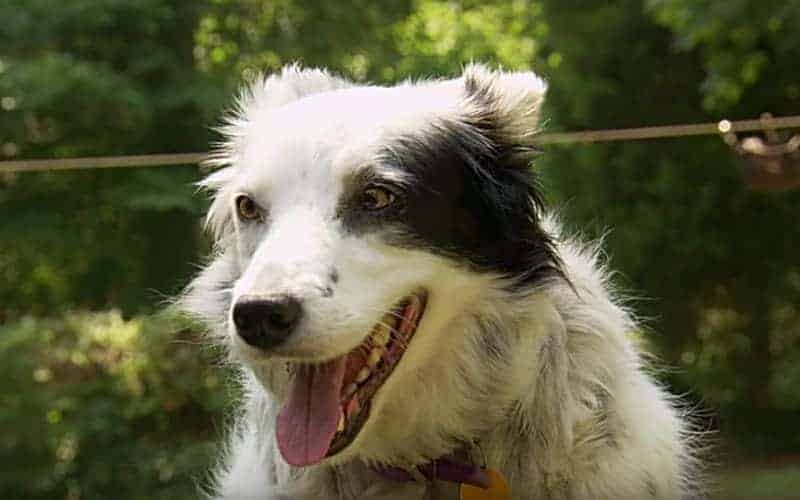
At first glance the two breeds look similar: medium-sized, athletic, often fluffy dogs in black-and-white or merle. Look closer and the differences show up.
- Build: both stand around 20 inches, but the Aussie is more solidly built. The Border Collie is generally lighter and racier.
- Coat: both have a thick double coat. An Aussie’s coat is medium-length, while a Border Collie can have a medium-length rough coat or a short, smooth coat (Chewy’s vet-reviewed breed comparison).
- Color: black, red, blue merle and red merle are possible in both breeds, but Border Collies come in a much wider range of colors.
- Ears: Border Collie ears are upright or semi-erect with tips that may fold; Aussie ears are triangular with a more noticeable fold.
- Tail: Border Collies have a long, low-set tail. Some Aussies are born with a natural bobtail, and tail docking is common in the breed, a practice the American Veterinary Medical Association opposes.
Temperament and Personality
Both breeds are smart, loyal and deeply attached to their people. Diana Smith, president of the Border Collie Society of America, told Chewy that Border Collies “tend to be laser-focused on their person and family.” Aussies, likewise, are happiest at their owner’s side (Chewy’s vet-reviewed breed comparison).
The difference is mostly one of intensity. Border Collies were bred to make independent decisions while controlling sheep, and many show the classic “eye,” an intense stare, along with stalking, crouching and a strong drive to control movement. Without an outlet, that drive can turn into obsessive habits like shadow chasing or fence running. Aussies are just as driven to work, but Kimber Shields, president of the United States Australian Shepherd Association, describes them as a little more adaptable: happy to run with you, and happy to sit on the couch with you after exercise.
Both breeds may try to herd children, other pets, joggers or bikes, so early socialization and training matter. Read more about how a Border Collie fits into family life in Is a Border Collie a Good House Dog?.
Exercise and Energy Needs
This is where the two breeds are most alike, and where most people underestimate them. Chewy’s comparison says Aussies and Border Collies typically need one to two hours of exercise every day, with dogs from working or sport lines needing more. UK vet charity PDSA recommends a minimum of two hours a day for a Border Collie.
Physical exercise alone is not enough. Both breeds need daily mental work: training sessions, scent games, puzzle feeders, herding or dog sports such as agility, obedience, rally, flyball and dock diving. A tired body with a bored brain is still a restless dog.
Two tools many herding-breed owners lean on:
- A flirt pole, such as the Squishy Face Studio Flirt Pole V2, lets a dog sprint, turn and practice impulse control (“wait,” “drop it”) in a small yard in a few minutes.
- A durable stuffable toy like the KONG Extreme gives a dog something calm to work on after exercise.
For more ideas, see 10 Low-to-No-Cost Games and Activities and Our Top 20 Recommended Toys for Collies.
Training and Intelligence
Both breeds learn quickly, and that includes bad habits. Border Collies are often called the smartest breed; Chewy calls the Aussie the Border Collie’s “salutatorian.” In practice, either dog will thrive with short, frequent, reward-based training and struggle with harsh corrections.
Focus on impulse control, a reliable recall, settling on a mat, and redirecting herding behavior into games or sports. Many owners find that structured activities like agility or herding lessons give these dogs the job they crave. Our guide Things to Consider Before Getting a Border Collie covers the training commitment in more detail.
Grooming and Shedding
Both breeds have a dense double coat and shed a lot, especially in spring and fall. Chewy recommends brushing every couple of days and bathing about once a month. A smooth-coated Border Collie is a little easier to keep tidy, but it still sheds.
Along with the coat, keep nails trimmed and teeth brushed. Our Rough Collie grooming tools guide covers brushes and rakes that work well on any double-coated herding dog.
Health Comparison
With the same 12 to 15 year life expectancy, both breeds are generally healthy, but they share several inherited concerns, including hip dysplasia, Collie eye anomaly, epilepsy and the MDR1 drug-sensitivity mutation (Chewy’s vet-reviewed breed comparison).
- Collie eye anomaly: the Royal Kennel Club lists both breeds for its CEA DNA test.
- MDR1: Washington State University notes that up to 75% of some herding breeds carry the mutation, which can cause severe reactions to certain drugs. Test your dog and share the result with your vet.
- Epilepsy: Cornell University College of Veterinary Medicine lists the Border Collie among breeds in which idiopathic epilepsy is more common.
Each breed also has its own tests. Border Collie breeders screen for trapped neutrophil syndrome and neuronal ceroid lipofuscinosis, among others, and the Royal Kennel Club lists a hereditary cataract test for Australian Shepherds. Whatever you choose, ask the breeder for the parents’ DNA and X-ray results. Feed a measured, high-quality diet; Chewy carries performance formulas suited to active dogs.
Which Breed Is Right for You?
Choose a Border Collie if you want an intensely focused partner for herding, agility or other dog sports, and you can provide two or more hours of daily activity plus regular training.
Choose an Australian Shepherd if you want a similarly smart, athletic dog with a sturdier build, and you like the idea of a dog that is a little more willing to switch off once its needs are met.
If neither sounds manageable, a calmer herding relative may be a better match. Our guide What Is a Rough Collie? explains why many people who love the herding look choose a Rough or Smooth Collie instead. And if you are leaning toward a Border Collie, read Things to Consider Before Getting a Border Collie before you commit.
Frequently Asked Questions
Is a Border Collie or Australian Shepherd better for a first-time owner?
Neither is an easy first dog. Either can work for an active first-time owner who is home a lot and committed to daily exercise and training. Aussies are often described as slightly more adaptable.
Which is bigger, a Border Collie or an Australian Shepherd?
The Australian Shepherd. The AKC lists Aussies at 40 to 65 pounds and Border Collies at 30 to 55 pounds, with similar heights.
Which breed has more energy?
Both are very high-energy. Border Collies are generally considered the more intense of the two, but both typically need one to two hours or more of exercise a day plus mental work.
Do Border Collies and Australian Shepherds get along?
Many do, and both enjoy the company of other active dogs. As with any dogs, introductions should be supervised and play monitored.
Do Australian Shepherds shed more than Border Collies?
Both shed heavily, especially seasonally. A smooth-coated Border Collie may leave a little less fur around, but neither is a low-shedding breed.
What is a Border Aussie?
A Border Aussie is a cross between a Border Collie and an Australian Shepherd. Expect a high-energy, intelligent herding dog with the needs of both parents.
You Might Also Like
Larry Brown
Larry Brown is an avid Collie lover. He writes about the breed from the yard and the driveway, not from a show catalog.