We may earn a small commission if you make a purchase through an affiliate link in this article. As an Amazon Associate we earn from qualifying purchases.
This is health information for owners, not a diagnosis and not veterinary advice. A veterinarian is who examines the dog and decides what to do. Nothing here is a dose, a treatment plan, or a reason to start or stop a medication on your own.
The health questions Rough Collie owners bring up are usually practical ones. A puppy packet full of acronyms. A vet asking whether the dog has been tested for drug sensitivity. A young dog with a crusty spot on the face. A middle-aged dog that is slower getting up. The dog usually looks fine across the yard. The problems that matter in this breed are mostly inherited, and most of them are invisible until someone looks in the right way.
On this page: collie eye anomaly · MDR1 · dermatomyositis · hips · PRA-rcd2 · lifespan · when to call a vet
New to collies? Grab our free checklist.
Our free, printable New Collie Owner Checklist covers what to prepare before your collie comes home, the first week, the first three months, vet questions, grooming and feeding. Join the Collie Chatter newsletter and we’ll email it to you.
What owners actually run into
New to the breed itself? What Is a Rough Collie? covers the dog. This page is the health hub.
The Collie Health Foundation’s health statement, approved January 9, 2024, names four genetic screens as the minimum for a breeding program: collie eye anomaly (CEA), MDR1, progressive retinal atrophy rod-cone dysplasia 2 (PRA-rcd2), and dermatomyositis (DMS). It also lists hip radiographs, through OFA or PennHIP, among the other checks breeders use. A pet owner does not need a breeding plan to care about the same list. Those are the results that show up on paperwork, and the conditions behind them are the ones worth understanding before a problem shows up at home.
The American Kennel Club’s Collie breed page, which covers both the rough and the smooth variety, says Collies are as a rule healthy, and it points buyers to the Collie Health Foundation, to an eye check for collie eye anomaly, and to the MDR1 mutation. That is a fair summary. It is not a promise about one dog.
Collie eye anomaly
Collie eye anomaly is an inherited developmental condition in the back of the eye. Dogs are born with it. You cannot see it by watching a dog walk across a room. The Collie Health Foundation says the physical changes are present before birth, and that a dog needs two copies of the mutation to be affected. The useful exam is by a veterinary ophthalmologist, usually at about 6 to 8 weeks, with the pupils dilated. A DNA result does not replace that exam. Many mildly affected dogs see adequately. Vision is the worry when the changes are severe or the retina detaches.
The longer explanation, including where sources disagree about blindness, “go normal” puppies, and what a carrier result means, is in Collie Eye Anomaly: What It Is and How It’s Tested.
MDR1 drug sensitivity
MDR1 (also called ABCB1) is a mutation that keeps a protein in the blood-brain barrier from doing its job. The Collie Health Foundation describes it this way: the natural barriers in the body are more permeable, so some drugs can reach the brain and build up there. Affected dogs can have neurological signs after certain medications. The Foundation lists weakness, lethargy, loss of coordination, disorientation, tremors, seizures, blindness, and death. The Orthopedic Foundation for Animals lists vomiting, diarrhea, lethargy, tremors, ataxia, excess salivation, seizures, respiratory arrest, and coma. If a dog shows signs like that after a drug, that is a call to a veterinarian now, not a wait-and-see evening.
How common it is depends on who you read, and those sources do not match.
- The Collie Health Foundation says that, depending on the source, 55 to 70 percent of the Collie population is affected.
- Washington State University’s breed table lists Collies at about 70 percent. The same WSU page also says approximately three of every four Collies in the United States have the mutant gene. That is about 75 percent, on the same site as the 70 percent table.
Neither figure is a result for your dog. WSU says the only way to know an individual dog is to test it.
What one copy means is another place the wording splits.
- The Collie Health Foundation says MDR1 is autosomal dominant, so one copy is enough for a dog to be affected. It says there is no such thing as an MDR1 carrier. Two copies are more severely affected. One copy is still at risk from common veterinary drugs.
- OFA says a dog with one copy (N/MDR1) may show multidrug sensitivity and will pass the variant to 50 percent of its puppies. The same OFA page then says a mating between two heterozygous dogs produces, on average, 25 percent of puppies with multidrug sensitivity. That sentence counts as if only the two-copy puppies “have” it, which does not sit cleanly next to “one copy may show sensitivity.”
Read a one-copy result as “this dog can react, and the vet needs the result in the file.” Do not read it as “carrier, so we can ignore it.” The Foundation’s result labels are normal/normal, mutant/normal, and mutant/mutant. OFA’s labels are N/N, N/MDR1, and MDR1/MDR1.
This post will not list doses or tell you which product to give. Washington State University keeps the problem-drug list, and it changes when new research is published. Two points on that list are worth knowing before you open a cabinet. WSU says loperamide (Imodium), at doses used for diarrhea, causes neurological toxicity in dogs with the MDR1 mutation and should be avoided in all of them. WSU also says some heartworm products that use ivermectin, milbemycin, selamectin, or moxidectin were found safe for MDR1 dogs when used at the labeled dose, and that other formulations of those drugs are a separate question. Which product, and whether a labeled dose fits this dog, is the veterinarian’s call. Do not adjust a dose because of something you read.
Put the result in the dog’s veterinary record before anyone needs it in a hurry. Five things you can do to help your Collie live a healthier life makes the same point. Parasite products are the question owners ask next. Parasite protection for dogs with the MDR1 gene is the longer piece on this site. Use it alongside WSU’s current list, not instead of it. Older write-ups, including some of ours, have used “carrier” for a one-copy dog and have quoted a single percentage. The Foundation and WSU, cited above, are the cleaner sources, and they do not fully agree with each other either.
Dermatomyositis
Dermatomyositis (DMS) is an autoimmune disease of skin and, in some dogs, muscle. The Collie Health Foundation says it is especially known in Collies and Shetland Sheepdogs. Lesions often start on the face and legs, sometimes as young as 7 to 11 weeks. The Foundation says most affected dogs have lesions by 6 months of age, and that maximum severity is reached at about 1 year. What you may see is hair loss, redness, scaling, crusts, or small blisters. In severe cases the skin can erode and scar.
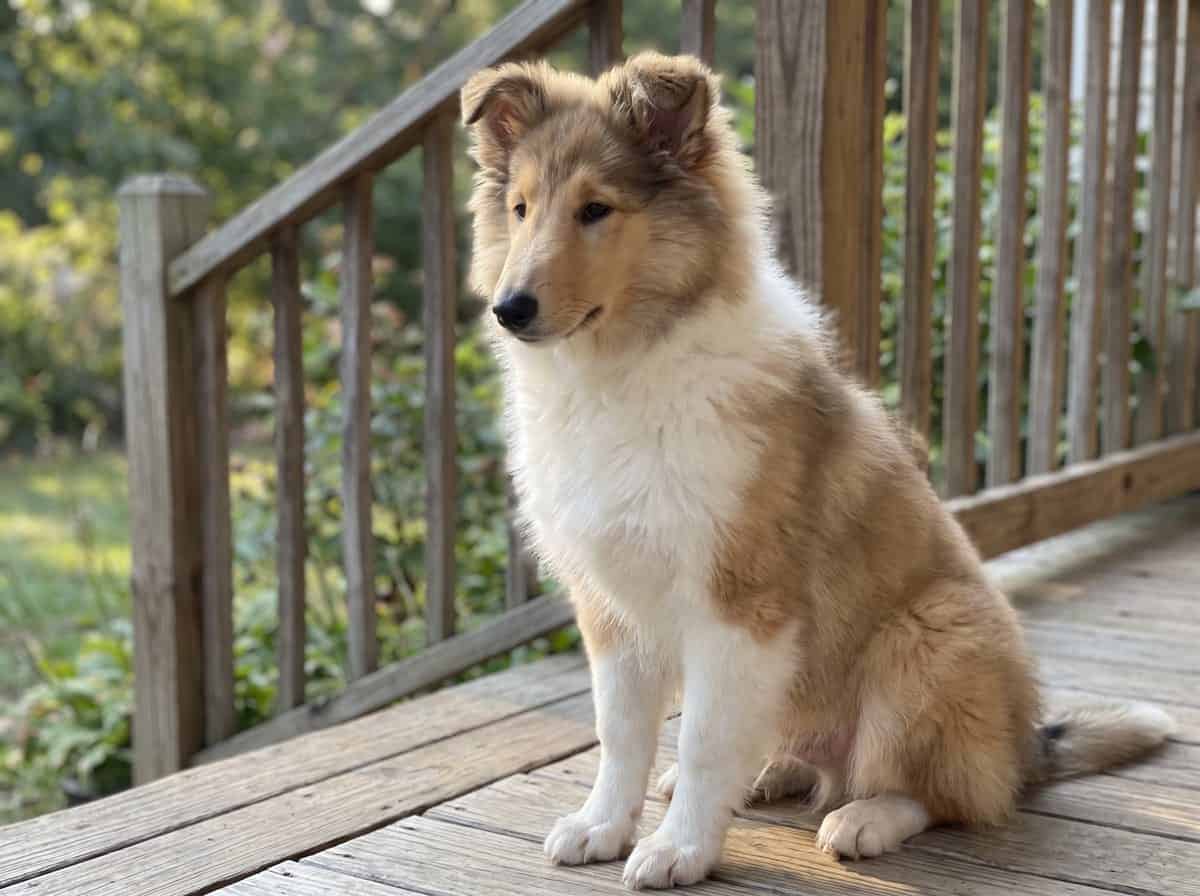
Muscle inflammation, when it happens, usually follows the skin lesions. Mildly affected dogs may have little or no muscle loss. The Foundation says severe cases can bring muscle wasting, trouble eating and swallowing, and then secondary pneumonia or megaesophagus. Some severely affected dogs develop an abnormal gait. A scaly face on a Collie puppy is a veterinary visit. It is not something to identify from a photo online.
The Foundation says the diagnosis is a skin punch biopsy, and electromyography when muscle disease is the question. The DNA test is not that diagnosis. It is a risk assessment. The Foundation is explicit: there is no “normal,” “clear,” or “carrier” result for DMS. The best result is low risk, and a low-risk dog can still develop the disease or pass risk alleles on. A 2017 study led by Leigh Anne Clarke at Clemson found three regions, called A, B, and C. UC Davis Veterinary Genetics Laboratory tests those three loci and reports low, moderate, high, or, for some genotypes that were scarce in the study, unknown risk.
The percent bands are the Foundation’s summary of that study, not a forecast for one dog: low 0 to 5 percent, moderate 33 to 50 percent, high 90 to 100 percent. UC Davis sorts genotypes into the same low, moderate, and high groups, and it adds unknown. The two pages are describing one test. They do not present the result in exactly the same boxes. The Foundation’s health statement adds that genes are only part of it. Sun, viral infection, and other environmental stress are associated with whether signs appear. Two low-risk parents can still produce higher-risk puppies. The Foundation says a breeding plan has to look at the actual genotypes, not at the word “low” alone.
Hip dysplasia
Hip dysplasia is a badly formed hip joint. The Collie Health Foundation says the severe form can lead to crippling lameness and painful arthritis, and that it is a polygenic trait thought to be hereditary and also affected by environment. It is not a single-gene test with a clear, carrier, and affected result. Diagnosis is radiographs. The Foundation names two systems, OFA and PennHIP, and says the X-rays are usually taken with the dog sedated so the joint can be positioned.
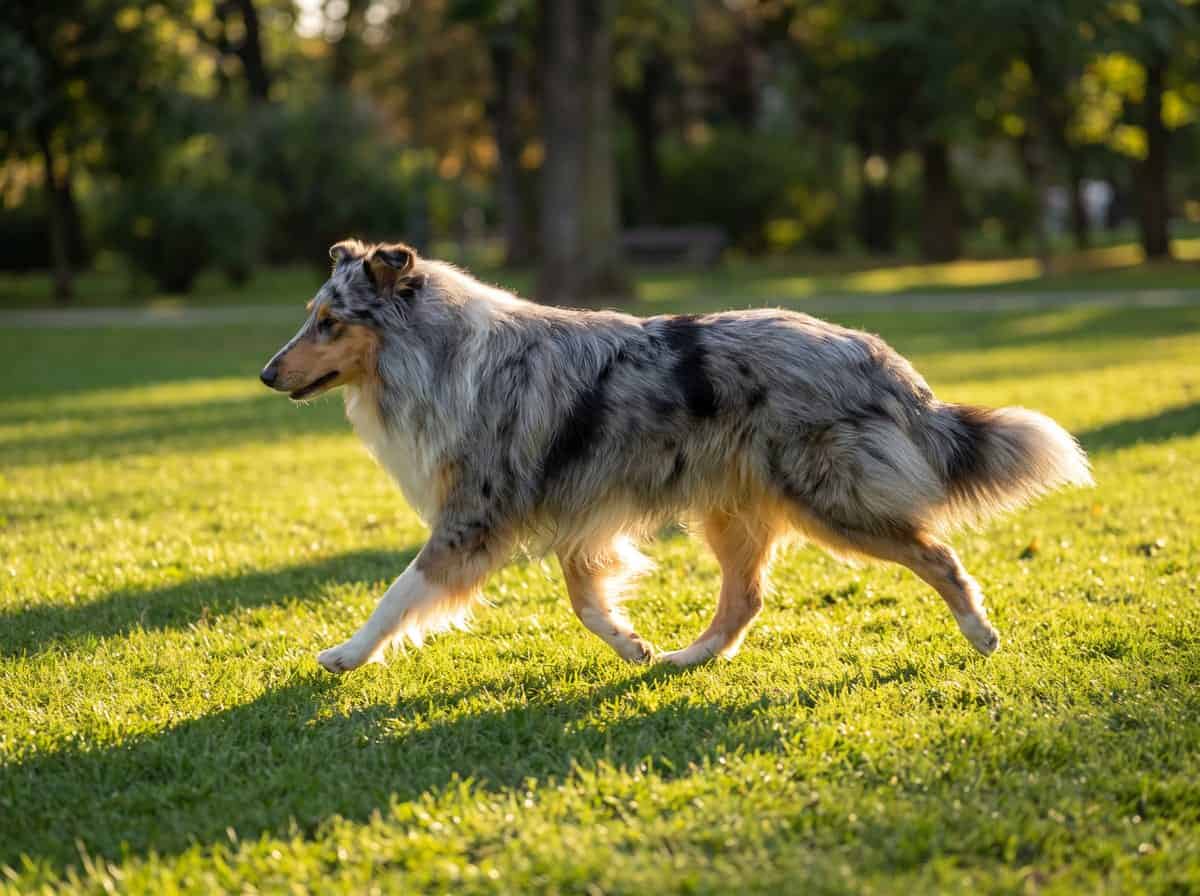
The Foundation cites the Orthopedic Foundation for Animals for a figure: 2.8 percent of Collies dysplastic, which it calls very low compared with other breeds. The OFA breed table that matches that number covers evaluations from January 1974 through December 2009. In that table the Collie row is 2,657 evaluations, 29.4 percent excellent, and 2.8 percent dysplastic. That is dogs whose X-rays were submitted to OFA. It is not a count of every Rough Collie. AKC’s general hip dysplasia article says the condition can occur in any breed, that it is hereditary, and that growth, exercise, weight, and nutrition can magnify a genetic tendency. Those are different claims, and both can be true: Collies are not a high-dysplasia breed in the OFA submissions, and an individual Collie can still have bad hips.
What an owner sees, when there is something to see, is lameness, trouble rising, or a gait that is off. Some dogs show signs young. AKC notes that others show them later, along with osteoarthritis. Stiffness after rest is a reason to call the vet. It is not a reason to decide the dog has hip dysplasia without X-rays.
PRA-rcd2, the other eye disease
Progressive retinal atrophy in Collies, PRA-rcd2, is not collie eye anomaly. The Collie Health Foundation’s health statement says the two are unrelated. PRA-rcd2 is a degeneration of the retina. The Foundation describes it as autosomal recessive, typically showing signs by about 6 weeks, and causing blindness by about 6 to 8 months. It also says that, through testing and a no-tolerance approach by breeders, PRA is rare in Collies today. The DNA test reports normal, carrier, or affected. A clear CEA result says nothing about PRA, and the other way around. Puppies still need the eye exam. The comparison is spelled out in the collie eye anomaly post.
How long Rough Collies live
The AKC Collie breed page lists life expectancy as 12 to 14 years. In the health text on that page, AKC says Collies typically live from 12 to 14 years and are as a rule healthy. That page is about the Collie, rough and smooth together. It is not a separate lifespan study of Rough Collies, and it is not a prediction for a dog that already has a serious form of one of the conditions above. I have not found a source that gives a different, Rough-only figure, so I am not going to invent one.
A pet dog and a breeding dog
For a pet, the useful outcomes are simple. Know the eye exam and the CEA result, because they answer different questions. Know the MDR1 result before a medication is chosen. If a young dog develops skin lesions, have a veterinarian look, and do not treat a DMS risk score as a diagnosis. If movement changes, ask about hips rather than guessing. The Foundation’s breeding minimum (CEA, MDR1, PRA-rcd2, and DMS, plus hip radiographs for breeding stock) is still the list I would want to see on a puppy’s parents.
A consumer DNA kit can screen a large health panel at home. It does not look inside the eye, it does not X-ray a hip, and it does not biopsy skin. Embark’s Breed & Health kit is the health panel, not the Breed ID kit. Embark publishes a condition page for MDR1 and one for collie eye anomaly. Confirm the current panel before you buy. Take any result to your veterinarian. It is a risk screen, not a diagnosis.

Breed and Health kit, not Breed ID. Embark publishes pages for MDR1 and collie eye anomaly, and this kit is the health panel. A result is a risk screen, not a diagnosis, and it does not replace an eye exam.
When to call a vet
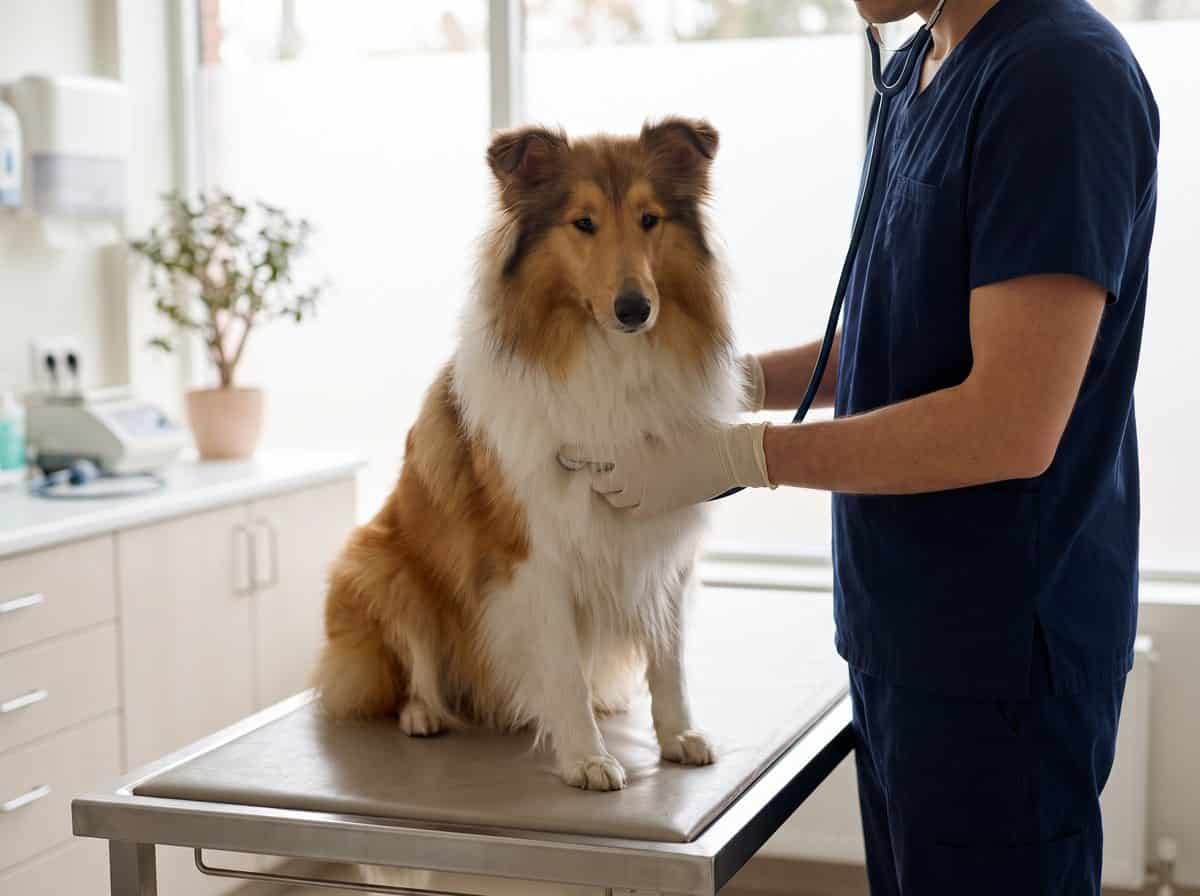
- Neurological signs after a medication. Weakness, stumbling, disorientation, tremors, seizures, or a dog that is suddenly not himself. The Collie Health Foundation and OFA both list signs in that range for MDR1-related toxicity. That is an emergency call, not the next routine appointment.
- Vision changes, a pupil that stays wide, or blood in the eye. Those can go with a retinal detachment in a dog with collie eye anomaly. The eye post has the detail. Same-day veterinary care.
- A puppy, especially one with no early eye exam and no DNA result on the parents. Ask for a veterinary ophthalmologist around 6 to 8 weeks, which is the window the Foundation, OFA, and AKC describe.
- Crusts, hair loss, or sores on the face, ears, legs, or tail of a young Collie. The Foundation says DMS lesions often start early. A veterinarian should see them. Do not scrape or treat them at home from a blog post.
- Lameness, trouble getting up, or a gait that has changed. Hips are one possible reason. Only radiographs sort that out.
- You are about to give a new drug, a dewormer, or an anti-diarrhea medicine, and you do not know the dog’s MDR1 status. Call first. Do not use loperamide while you wait. WSU says to avoid it in every dog with the mutation, and an untested Collie is not a dog you should assume is clear.
Vet visits for breed-related conditions can come up without much warning, so pet insurance is worth looking into while your Collie is healthy. You can get a quote from Lemonade Pet Insurance.
Get a Pet Insurance Quote from Lemonade
Sources
- Collie Health Foundation health statement, approved January 9, 2024. Minimum screens (CEA, MDR1, PRA-rcd2, DMS), hip radiographs, and the note that PRA is unrelated to CEA.
- Collie Health Foundation, MDR1. The 55 to 70 percent range, autosomal dominant inheritance, no-carrier wording, signs, and result labels.
- Washington State University, MDR1 in dogs. The Collie table at about 70 percent, the “three of every four” sentence, and the problem-drug notes including loperamide and labeled heartworm products.
- Washington State University, problem medications for dogs, March 1, 2022, kept current as research is published.
- OFA, Multiple Drug Sensitivity (MDR1). Signs, breeds, and the N/N, N/MDR1, and MDR1/MDR1 key, including the heterozygous mating sentence.
- Collie Health Foundation, dermatomyositis. Age of onset, skin and muscle signs, biopsy, and the low, moderate, and high risk bands from the Clarke study.
- UC Davis Veterinary Genetics Laboratory, susceptibility to dermatomyositis. Three-locus risk test, including an unknown-risk result.
- Collie Health Foundation, hip dysplasia. Polygenic trait, OFA and PennHIP, and the 2.8 percent figure cited from OFA.
- OFA hip dysplasia statistics, breeds with at least 100 evaluations, January 1974 through December 2009. Collie: 2,657 evaluations, 29.4 percent excellent, 2.8 percent dysplastic.
- AKC, hip dysplasia in dogs. Any breed, hereditary, and environment can magnify it.
- AKC, Collie breed page. Life expectancy 12 to 14 years, the “as a rule healthy” line, the 6-to-8-week eye check, and MDR1.
- Collie Chatter, collie eye anomaly. The deeper CEA piece this hub points to.
- Embark, MDR1 drug sensitivity and Embark, collie eye anomaly. Condition pages behind the Breed and Health kit mention. Not a diagnosis.

Other Articles